
The Telco TV Opportunity Map (Part 3)
Telco TV has reached a moment where real reinvention is on the table. The convergence of faster broadband, mature streaming technologies, smart devices, and changing digital habits is pushing TV far beyond the old model of a fixed, utility-like service. For operators willing to modernize, TV can become a dynamic entertainment platform that unlocks new revenue streams, deeper engagement, and less operational complexity, all built around how people actually consume content today.
This is exactly what Part 3 focuses on: the opportunity map for telcos moving from legacy IPTV to modern, scalable OTT platforms, and the practical realities that determine whether the transformation succeeds.
This post is part of a three-part series based on a complete, more detailed whitepaper, The Telco TV Playbook.
In this post, we will cover:
- The biggest opportunities unlocked by modern OTT platforms, from modular cloud architectures to super-aggregation and smarter discovery
- The strategic and operational decisions that make or break a transformation, including platform approach, migration planning, and device strategy
- Where telco TV is heading over the next 5 to 10 years, and what operators should prepare for as the industry continues to converge and evolve
- A set of actionable recommendations to help telcos modernize with confidence and turn TV into a long-term strategic asset
The opportunity map
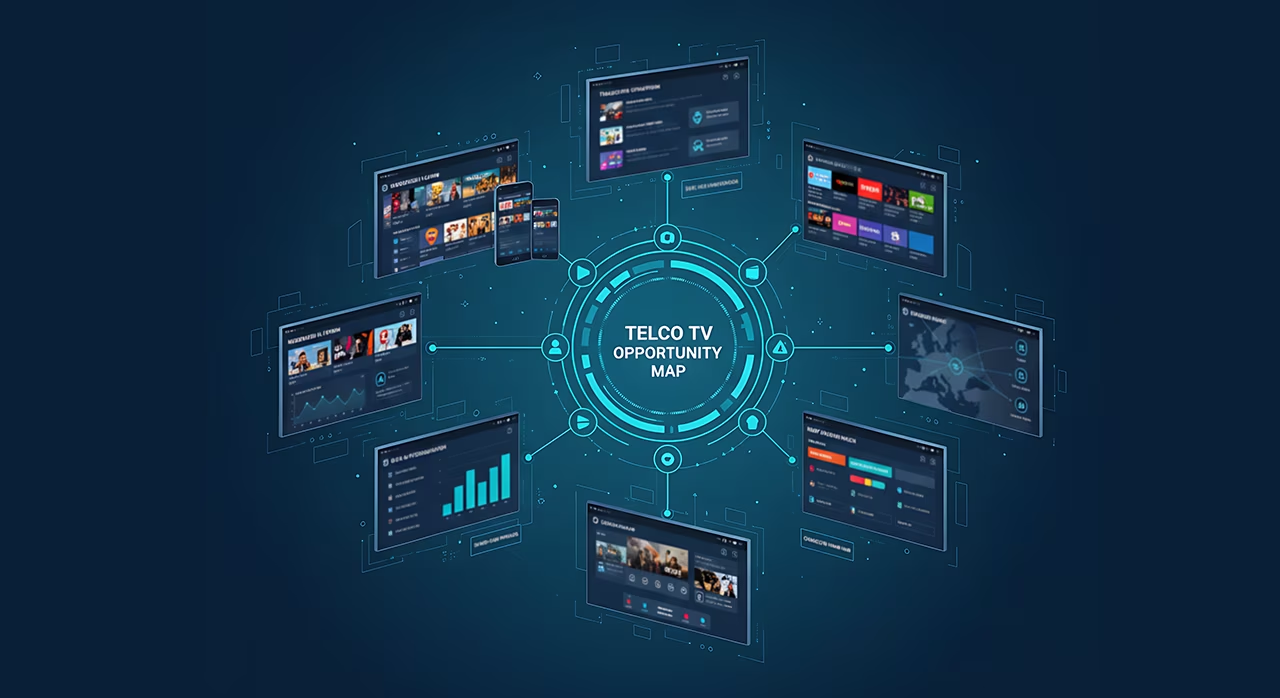
Modernize the platform
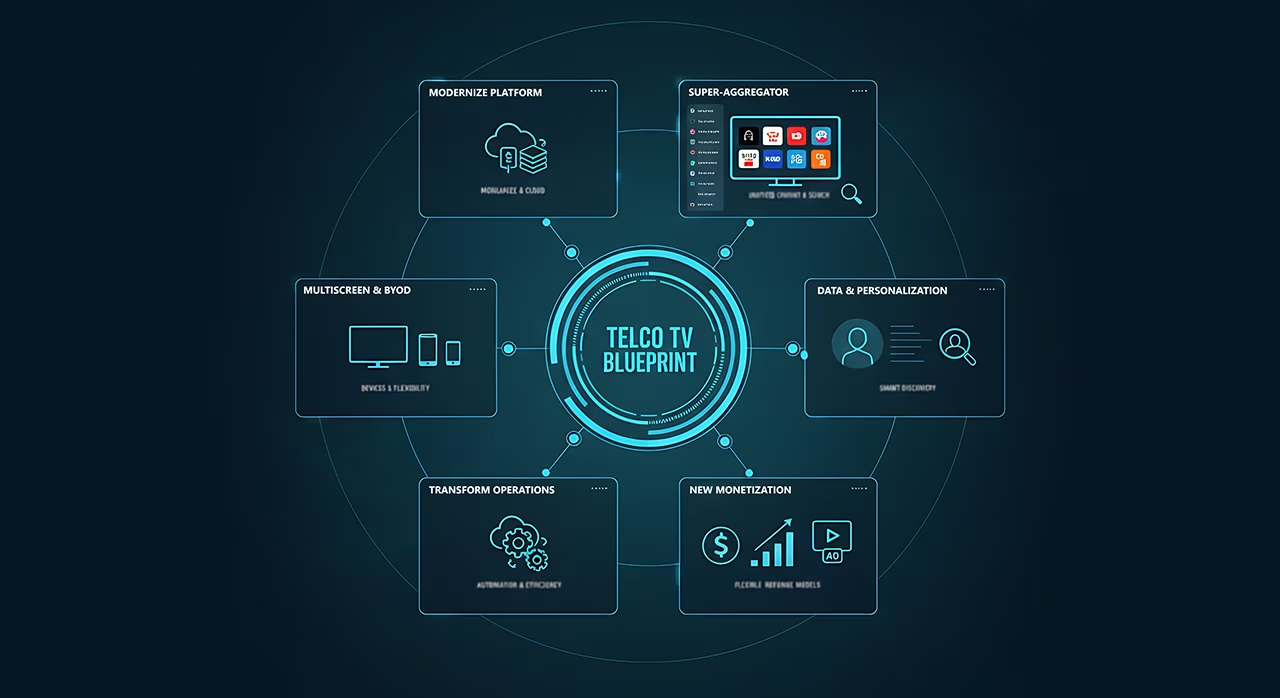
For many telcos, the biggest unlock starts with the platform itself. Legacy IPTV stacks were often built as tightly coupled systems where backend services, middleware, and device logic are intertwined. Modern OTT architectures flip that approach: modular, API-first, and built on microservices that can evolve independently.
In practical terms, moving to a cloud-ready platform can enable operators to ship improvements weekly or monthly instead of once or twice a year, scale up for peak demand during major live events, and reduce the dependency on proprietary hardware by running apps across a wider device ecosystem.
Just as importantly, modernization improves how the business runs day to day. Cloud platforms make automation easier, reduce manual operational work, and let operators optimize infrastructure based on real usage rather than overbuilding for worst-case scenarios. Over time, this supports a lower total cost of ownership and healthier innovation dynamics.
Embrace multiscreen and BYOD without abandoning STBs
Viewers now expect TV everywhere: mobile, smart TVs, laptops, web, and streaming sticks. A modern OTT strategy makes that possible and opens the door to BYOD, where customers use devices they already own rather than relying only on operator-issued boxes.
BYOD brings clear advantages: lower CapEx, simpler logistics with fewer physical boxes to store and replace, and the ability to expand reach beyond the traditional fixed footprint using pure OTT delivery. It also aligns with customer habits, because many people prefer the interfaces and performance of devices they already use daily.
At the same time, STBs still have a role. Premium set-top boxes can be the right fit for older households, customers who want a consistent experience, or scenarios where specific capabilities and compliance requirements matter. The real opportunity is an agile device strategy that offers choice, with STBs as an option rather than the default.
Become a super-aggregator of content and apps
Content fragmentation has created a massive simplicity gap. Customers bounce between apps, subscriptions, and logins, and the experience can feel exhausting. This opens the door for telcos to become trusted super-aggregators: one interface, one bill, and one place to search and discover.
Super-aggregation is more than placing apps on a set-top box. It means integrating global and regional streaming apps into the telco UI, blending local channels with on-demand catalogs and OTT libraries, enabling unified search across everything, and reducing friction through single sign-on and integrated billing. It also enables smarter packaging, bundling OTT services with broadband, mobile, and TV tiers in ways that feel coherent to customers.
Data, personalization, and intelligent discovery
As catalogs grow, discovery becomes the product. Modern platforms let telcos use data responsibly to personalize home screens, deliver recommendations that blend linear, VoD, and integrated OTT catalogs, and unify search so users can find content regardless of where it is hosted.
This also enables editorial and behavioral rails that keep engagement high: trending, continue watching, sports moments, and other curated experiences that reduce decision fatigue.
A practical example is Discover and Watch, where content is dynamically surfaced based on viewing behavior and preferences to increase engagement and satisfaction.
Beyond the classic EPG and static VoD menus, some newer UX patterns are becoming increasingly relevant:
- Short-form previews that help users sample content quickly and jump straight into the full program
- More advanced voice interaction for search and control
- A remoteless flow where the mobile app becomes the primary discovery surface and casting becomes a natural one-tap action
New monetization models beyond traditional pay TV
Modern OTT makes it easier to diversify revenue beyond a classic subscription-only model. With FAST growth, regional advertising networks, and hybrid subscription plus advertising models, telcos can introduce flexible tiers tailored to different customer segments and price sensitivities.
The opportunity menu can include ad-supported tiers, targeted advertising using non-sensitive usage signals, FAST channels that expand content at low rights cost, OTT bundle discounts that create clear upsell paths, partner revenue shares, and premium add-ons such as 4K sports or niche packs.
Expand beyond the core network: on-net and off-net
Historically, telco TV was limited to subscribers on the operator’s own fixed network. OTT removes that limitation and turns TV into a brand extension opportunity.
With OTT-powered services, telcos can reach mobile-only customers, offer app-based TV nationally even where they have no infrastructure, support roaming and remote viewing, expand into B2B and hospitality, and extend services to smaller ISPs through wholesale partnerships, including niche providers focused on diaspora communities.
This shift effectively turns the TV platform into a broader entertainment service with a bigger addressable market than the legacy IPTV footprint ever allowed.
Transform operations with cloud and automation

Modern OTT platforms can make operations lighter and more proactive. Tasks that used to require manual intervention, such as content ingestion, metadata updates, log analysis, device activation, and troubleshooting, can be supported through automated workflows and real-time monitoring.
Cloud-based operations can reduce overhead, minimize downtime, simplify deployments, enable remote updates, improve QoE monitoring, and strengthen customer support with proactive diagnostics. The net effect is a shift in internal effort from maintenance to innovation.
Reposition TV as a core digital service for the connected home
The living room is becoming a central digital hub, and the TV screen is increasingly an interface for apps, gaming, communication, and ambient experiences. That creates an opening for telcos to position TV as the foundation of the connected home.
Opportunities include integrating smart home controls into the TV interface, offering unified home dashboards, pairing TV with home security or automation services, and using TV as a family communication surface. For operators that already own the broadband relationship, this is a natural way to expand value in the household.
Practical playbook for transformation
Build vs buy vs partner: choosing the right model
Once a telco decides to modernize TV, the next question is simple to ask and hard to answer well: do we build the platform ourselves, buy a ready-made solution, or partner with a specialist provider? The choice you make here will shape your speed, cost structure, and ability to innovate for years.
Build (in-house) gives the most control and customization, but it is also the slowest and most resource-intensive route. It typically demands large engineering teams, long development cycles, and an ongoing maintenance commitment that can quietly swallow budgets and attention. In practice, many telcos find that internal development struggles to keep feature velocity high enough to match the market.
Buy (commercial platform) is usually the fastest path to launch or upgrade. Vendors often provide mature feature sets out of the box, including multiscreen apps, content tools, security modules, and device integrations. The trade-off is reduced control over the roadmap, although strong operator-vendor collaboration can influence priorities and mitigate some of that risk.
Partner (specialist provider, often cloud-native end-to-end) aims to balance flexibility with efficiency. This approach can let the telco shape the user experience and workflows while relying on a specialist for the core platform and operational expertise. The best choice depends on goals, available talent, innovation priorities, and time-to-market requirements.
Migrating from legacy platforms without breaking the business
If modernizing the platform is the opportunity, migration is often the hard part. Legacy IPTV environments can be deeply embedded in operations and in customer homes, especially when the service is tied to old middleware, device fleets, and tightly integrated back office systems.
A strong migration plan usually covers five practical areas:
- Service continuity: how to transition subscribers with minimal disruption, often by running parallel operations during a controlled rollout
- Device strategy during the transition: deciding whether customers need device swaps or whether firmware upgrades and app-first rollouts can carry a big part of the load
- Catalog and metadata migration: ensuring content data is migrated or rebuilt cleanly so the new UX has strong search, discovery, and navigation
- Subscriber entitlements: carrying over packages, rights, parental controls, recordings rules, and other service permissions reliably
- Critical integrations: testing end-to-end connections to CRM, billing, OSS and BSS, and conditional access systems thoroughly before scaling rollout
Phased migrations often work best. A common pattern is launching the new service on multiscreen devices first while keeping the legacy set-top environment active, then gradually migrating user groups, regions, or device segments over time. Clear customer communication is a major success factor: explain to customers what is changing, why it is improving, and what customers need to do, if anything.
Organizational and cultural transformation
Modern TV services move at a different pace than traditional telco programs. Where telcos have historically been optimized for long planning cycles and infrastructure stability, digital TV requires frequent releases, rapid iteration, and product-centric thinking.
That typically means building or strengthening capabilities in:
- UX and UI design
- app development across multiple platforms
- metadata operations and content curation
- analytics and digital product management
The other big shift is how teams work together. Modern OTT workflows are highly cross-functional, and silos that were tolerable in legacy IPTV can slow everything down. Many telcos address this through agile ways of working, empowered product owners, engagement-focused KPIs, and dedicated cross-functional TV squads that bring network, IT, product, and content stakeholders into one execution unit.
Device strategy: balancing STBs and BYOD
A modern device strategy sits right at the intersection of customer satisfaction and cost efficiency. Telcos generally need to balance three paths: proprietary set-top boxes, operator-branded Android TV devices, and a BYOD model where customers use smart TVs and streaming sticks.
Set-top boxes still make sense in specific scenarios, such as:
- supporting older households that value a consistent, familiar experience
- ensuring uniform UX across the whole base
- enabling premium features like multicast or operator-specific apps
- meeting strict DRM or regulatory requirements
But an STB-only approach increases CapEx, logistics, and support complexity. BYOD expands reach and reduces hardware dependence. While it does require ongoing app development and testing, it can significantly reduce installation and maintenance costs and helps operators acquire users beyond the traditional footprint.
Many operators land on a hybrid approach: premium STBs for high-value households or hospitality deployments, and smart TV apps as the default entry point for mainstream users.
Network and CDN planning for ABR traffic
OTT delivery behaves very differently from multicast IPTV. Adaptive bitrate streaming changes the load profile and introduces new planning priorities: CDN capacity, peering, caching, latency management, and in-home Wi-Fi performance.
Peak-event readiness matters most during major live sports, when large numbers of viewers stream simultaneously at high bitrates. Operators need CDN architectures that minimize latency and prevent buffering, sometimes supported by local caching or partnerships with regional CDN providers to improve QoE and reduce backhaul costs.
One reality worth calling out is that customer complaints are often driven by home Wi-Fi, even when the platform is performing well. Managed Wi-Fi, mesh systems, and better gateways can materially improve perceived service quality and reduce support calls.
In many emerging markets, the equation shifts again. Limited bandwidth and intermittent connectivity make resilient adaptive streaming essential, with strong error handling, efficient compression and codecs, and an offline-friendly approach. A key capability highlighted in the playbook is download-to-own, allowing users to download content during stable connectivity and watch later without streaming issues.
Rights, metadata, and consistent UX across devices
A modern TV service is only as strong as the operational backbone behind it. Rich catalogs, catch-up, nPVR, and offline features all depend on clear rights handling, while discovery and personalization depend on high-quality metadata.
Rights need to be managed carefully because different features may require specific licensing agreements, especially for catch-up, nPVR, and download-to-own scenarios.
Metadata must be accurate, enriched with artwork and editorial descriptions, and multilingual when needed. Weak metadata pipelines can undermine even the best user interface, because search and recommendations become unreliable.
Then there is the device reality: every smart TV platform and streaming device has its own guidelines, certification processes, and limitations. Operators need to balance a native feel on each device with a unified brand experience across screens, so customers recognize the service and can move between devices without friction.
Measuring success with KPIs and data-driven loops
Launching or upgrading a TV service is only the start. Long-term success comes from continuous optimization, guided by KPIs that cover both business performance and experience quality.
Typical KPI groups include:
- Business outcomes: churn reduction, ARPU uplift, subscriber growth, upsell conversion
- Engagement: viewing time, continue watching usage, search usage, feature adoption
- Quality and reliability: streaming quality indicators, app stability, platform responsiveness, overall customer satisfaction
The real advantage comes when these metrics can be analyzed in near real time. That enables faster improvements to personalization, proactive issue resolution, smarter content acquisition decisions, and clearer product development priorities.
Where telco TV is heading
Telco TV in the next 5 to 10 years: what to prepare for
The next decade of telco TV will be shaped by one big theme: convergence. Linear broadcast, streaming libraries, interactive formats, and new device experiences are blending into a single, fluid viewing environment. For telcos, this is both a challenge and an opportunity, because it pushes operators to evolve from channel providers into national-scale entertainment platforms.
On the experience side, the bar will keep rising. Higher-quality formats such as HDR, high frame rate sports, immersive audio, and more consistent low-latency streaming will become more common, especially for premium content. Over time, operators will also need to be ready for new viewing patterns, including multi-angle sports experiences and more interactive content journeys.
At the same time, the living room will become even more connected. Smart home devices and TV interfaces will increasingly overlap, and telcos will have a chance to tie entertainment into broader connected home services, from security and automation to household dashboards and family communication.
AI-driven capabilities will also move from optional to expected. Smarter search, better recommendations, and more personalized home screens will become key differentiators as content catalogs expand and customers become more selective. This will also support more dynamic bundling and monetization, where offers adapt to customer behavior and price sensitivity.
Behind the scenes, delivery architectures will keep evolving. Multi-CDN strategies, edge computing, cloud DVR, and AI-assisted network optimization will become increasingly important to ensure performance at scale, especially during peak events. Operators will invest more in end-to-end QoE visibility and proactive operations, because customer tolerance for streaming issues continues to shrink.
Finally, the platform business will expand. More telcos will offer TV-as-a-service models and wholesale platforms to smaller ISPs and partners, extending reach beyond their own footprint and turning TV platforms into scalable B2B assets.
Strategic recommendations for telcos
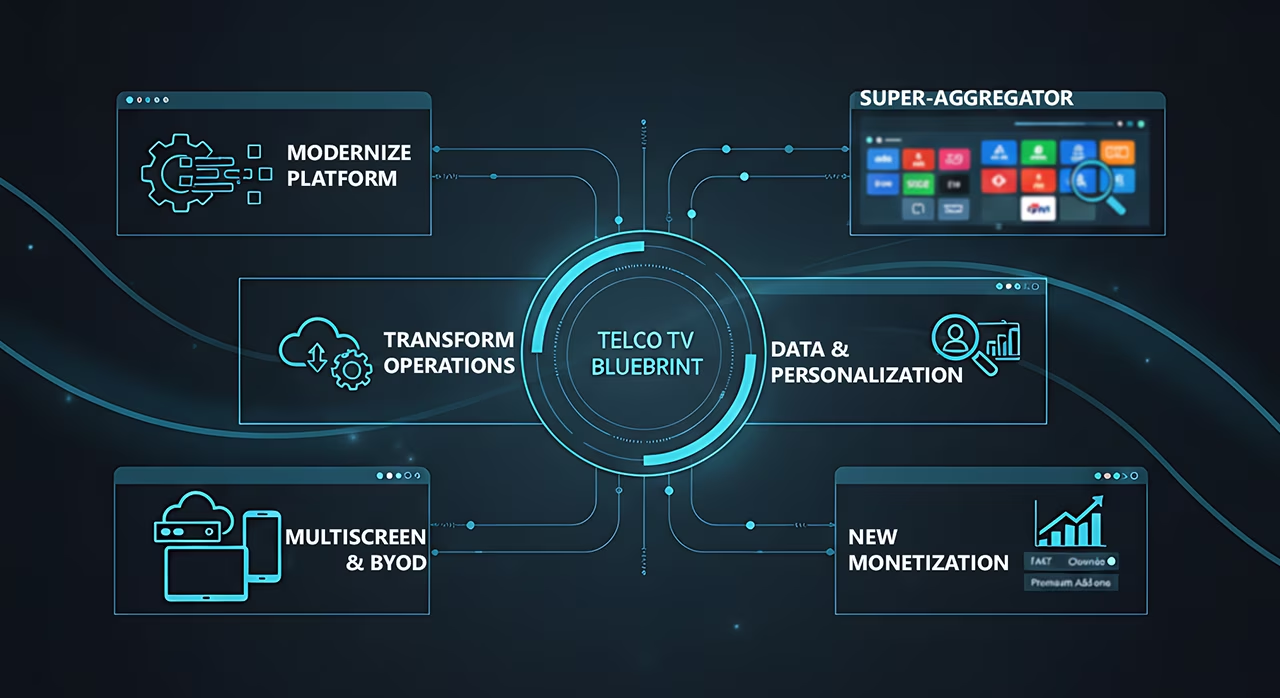
The opportunity is clear, but it only pays off when telcos treat TV as a strategic asset rather than a legacy add-on. A strong modernization approach typically includes the following priorities.
Modernize the platform to unlock agility
Prioritize modular, cloud-ready architectures that support fast iteration, easy integrations, and elastic scaling. Without platform agility, it is difficult to compete on experience, speed, and partnership readiness.
Lean into telco advantages instead of trying to out-stream the streamers
Telcos have unique strengths: network control, integrated billing, local relevance, and bundling power. Use them to create an experience that is simpler and more unified than a collection of standalone apps.
Make super-aggregation a core strategy
Help customers solve content fragmentation with one interface, one search, and integrated billing, while building smarter packaging across broadband, mobile, and TV.
Invest in discovery, personalization, and UX excellence
With expanding catalogs, discovery is where value is created. Strong metadata pipelines, personalization, and intuitive navigation are no longer optional.
Adopt a flexible device strategy
Reduce default dependence on set-top boxes while still supporting them where they add value. Use BYOD and smart TV apps to expand reach and lower the cost of scale.
Use data and analytics to drive continuous improvement
Track KPIs across business outcomes, engagement, and quality, and build feedback loops that translate insights into product decisions quickly.
Prioritize operational excellence through automation
Modern operations should reduce manual work, improve reliability, and lower support burden. Automation and proactive diagnostics free teams to focus on innovation.
Prepare for connected home opportunities and new formats
As TV, smart home, and new viewing experiences converge, telcos can grow their role in the household by bundling and integrating services in ways OTT-only players cannot.
The modernization payoff
The shift from legacy IPTV to modern OTT platforms is about more than keeping up with streaming trends. It is a pathway to faster innovation, broader reach, new monetization options, and a stronger position in the connected home.
For telcos, the payoff is clear when modernization is executed well: lower operational friction, a better customer experience across devices, and a platform that can support super-aggregation, personalization, and future formats without constant reinvention.
If you want the complete, detailed version of this framework, the full Telco TV Playbook whitepaper goes deeper into the strategy, the economics, and the practical implementation patterns that operators are using to modernize successfully.